Truman Manifolds
Inherited ground that nobody tested is eroding, and a thing’s purpose is the part that stays.If domains are basins held apart by ridges, AI is the erosion wearing those ridges down, and telos, what a thing is for, is the ground that does not drain. The argument comes from one anonymous comment and is unverified.Truman Burbank, The Truman Show — Truman finds the edge of the set by walking into it.
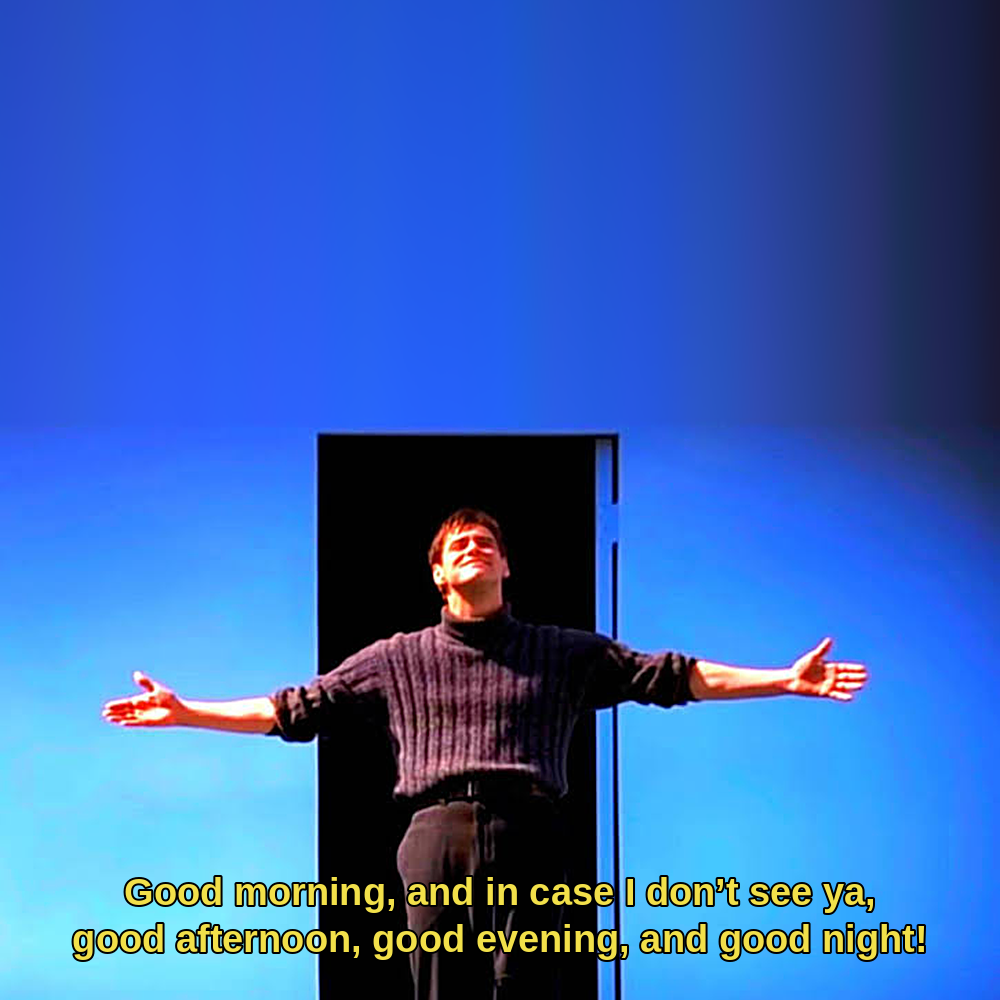 Subtitles on the image read: “Good morning, and in case I don’t see ya, good afternoon, good evening, and good night!”
In late August 2026 an anonymous comment in a Reddit thread about a model-capability timetable argued that AI is the first real test of much of what people rely on. Most of that was handed down and never worked out: the law, the idea of fair play, the shape of a career, the way a market pays for work. The comment came as eight headed notes, plus a short clarification of two of them when asked, and none of it has been verified.
A lifetime, or a few family generations, covers about a century of change, a span the comment calls the “pissant lens”. Against geological time (eons, eras, periods, epochs) a century barely registers, and people still generalise from it to the whole.
Humanity has not had its own Chicxulub, the asteroid strike that ended the dinosaurs. It has had something closer to “ontological shock”.
The comment’s blunt word for that handed-down material is “breastfeeding”: expectations taken in without examination, such as the law of the land, opportunity, fairness and human rights. The objection is to process, not to the ideas, which the clarification called wonderful. Nobody did the hard work of building themselves and their societies around them. People found them in place and took that as proof they were philosophically and rationally sound.
When knowledge and intelligence start moving, which may happen in the near to medium term, the expectations nobody built go bad first. The people standing on them are the ones worried or hurt.
Asimov’s line about prejudice handing a person pre-built conclusions makes the same point. As Anxiety Kernels sets it out, a detector (a written rule that fires on a condition) differs from a prejudice in upkeep: whether anyone priced the rule, dated it and left room to challenge it.
How long a conclusion has gone unchecked changes the cost. A threshold set last month can be dated and revisited. A century of ordinary life that never broke is much harder to date and far more expensive to reprice.
The film Donnie Darko, in which a teenager is pulled towards an event he cannot avoid, is a fair picture of how little agency people have. On that view people are pulled towards inevitable events, decision may be made in block time (the view that past, present and future all exist at once), and thinking otherwise is ego-based delusion. Arguing over how things could or should have gone is a post-mortem, much like presidential elections.
A society’s direction, then, is the sum of everything moving in it, down to every atom and molecule, and one person’s push counts for little against the change already coming. Steering at that scale mostly means accounting for what has already happened, unless there is an external kinetic or divine intervention. The point concerns how small agency feels and takes no position on free will.
AI may be, loosely, humanity’s first contact with a novel life-form on Earth, as the comment put it. Another life-form would be met with wonder. In many places AI is met instead with “milk-teeth reflexes”, reactions that would be called bigotry if they were aimed at people.
The influence of something alien to the existing way of life and livelihood is real, and likely to be highly disruptive and painful over the foreseeable medium term. In the comment’s view, defending the status quo is still “fucked”, and clinging to bygone ways because the shock is unbearable is a decision made out of fragility. The alternative comes from E.T., the film in which a boy befriends a stranded alien: change one’s ways, understanding and philosophy.
Kant split the world into things as they appear (phenomena) and things as they are in themselves (noumena). In geological terms that is regolith over bedrock. The loose layer on top can be surveyed, and the solid rock below it has not been.
- Regolith
- The perceived layer of appearances and phenomena, the news included. It is the only layer anyone observes.
- Bedrock
- Stood on and never inspected: Kant’s noumena, and in practice the assumptions older than the arguments that rest on them.
The comment takes Kant’s picture as the canvas nearest to bedrock, deeper than “some pissant creed”, without committing to transcendental idealism, Kant’s full position.
Bedrock is found only when something on top of it gives way.
Knowledge, information, economics and the rest have a shape. Each domain is a basin, held apart from its neighbours by ridges. Lake Capitalism, for example, is fed by the middle-class watershed, the higher ground that drains into it. Fields of study, professions, trades, economies and ecosystems are other lakes on the same surface.
Too Much World uses the same surface to decide where attention is worth spending. Repeated outcomes settle in basins, the way a million raindrops show where the water goes, and attention belongs where a small change can still send the path to a different ending. On that surface, position decides what a small change does.
The basins also show where things come from, such as fields fed by enrolment and trade, and the ridges show what keeps them apart.
Basin and ridge, at rest and cut
A ridge can also wear down.
Suppose the watershed weathers down to a smooth alluvial plain, and the edges of the ponds and the lakes are scoured by erosion and breached, draining them to the basin below. Water finds the lowest point, the one closest to bedrock. Erosion consolidates the domains and exposes new bedrock: knowledge, information and philosophy about the world. Skills, markets and economies have always shifted with conditions like these, but not at this velocity.
Erosion: watershed, plain, breach, bedrock
Nobody decides anything in the four stages. Each follows from the one before, and domains that competed by staying separate end up competing on depth.
In Too Much World a basin is permanent, and Anxiety Kernels, on untested surfaces whose fragility is revealed rather than caused, gives it no ending either. Erosion makes a basin temporary, a shape on a surface that is still weathering.
Touchstone
Security is the one place the argument offers something that looks checkable. The Claude Mythos cyber-security epoch is the comment’s name for a recent turn in security, which it calls a touchstone and everyone’s “oh shit” moment: a paradigm shift in how the security of everything that makes the digital world spin must now be examined.
the only novel aspect was that all of a sudden we were naked for ‘acting like’ rather than practicing what we preach— Anonymous comment on r/accelerate, August 2026
The comment says industry and academic reports on pre-mythos cyber maturity, from SME up to enterprise and government, mostly found “utilitarian apathy” to be the status quo, but it names none, so the claim is unchecked.
The turning point is being caught acting, the same reading Anxiety Kernels gives in its point about GRC (governance, risk and compliance). In the basin picture that is a basin erosion event: the practice turns out to have been the exposed part all along.
Telos is Aristotle’s word for the final cause or inherent purpose of a thing. The telos of an acorn is to become a mature oak tree.
This is what is valuable and transcends the above — rain or shine, Skynet or no Skynet.
Anonymous comment on r/accelerate, August 2026
What is valuable goes unnamed. The nearest analogy is buying a house or a car, or making another major decision: what does due diligence look like over the near to medium term, without relying on what someone else says?
A handed-down conclusion is one where someone else did the working. Due diligence means doing the working oneself, on ground that will still be there after the basins drain. Anxiety Kernels gives a version of this in the bedrock baseline of vigilance, which is always on, priced, and cheap enough that switching it off would be a decision rather than a saving. Due diligence is that baseline applied to a whole life, a floor kept whether or not anything is happening.
One instrument for holding that floor is the Telos System, a set of printable planner and diary pages written up separately as a concept. It is a design and is not offered as evidence.
Method and sources
A plain restatement of one anonymous comment in the d/rksci house voice. It measures nothing and is not evidence for the frame it restates, and the source’s substantive claims are unchecked. The two quotations are the comment’s own words, marked assumed below, and so are the coined terms in quotation marks. The three cross-referenced pieces are this site’s and were published before the comment, with no sign its author read them.
- The Truman Show (1998), directed by Peter Weir, written by Andrew Niccol, Paramount Pictures · the hero still, extended with sky and re-subtitled for commentary
- Immanuel Kant · the noumenon as the layer beneath appearances; the source’s own restatement is regolith over bedrock
- Aristotle · telos as final cause; the acorn and the mature oak are the source’s own example